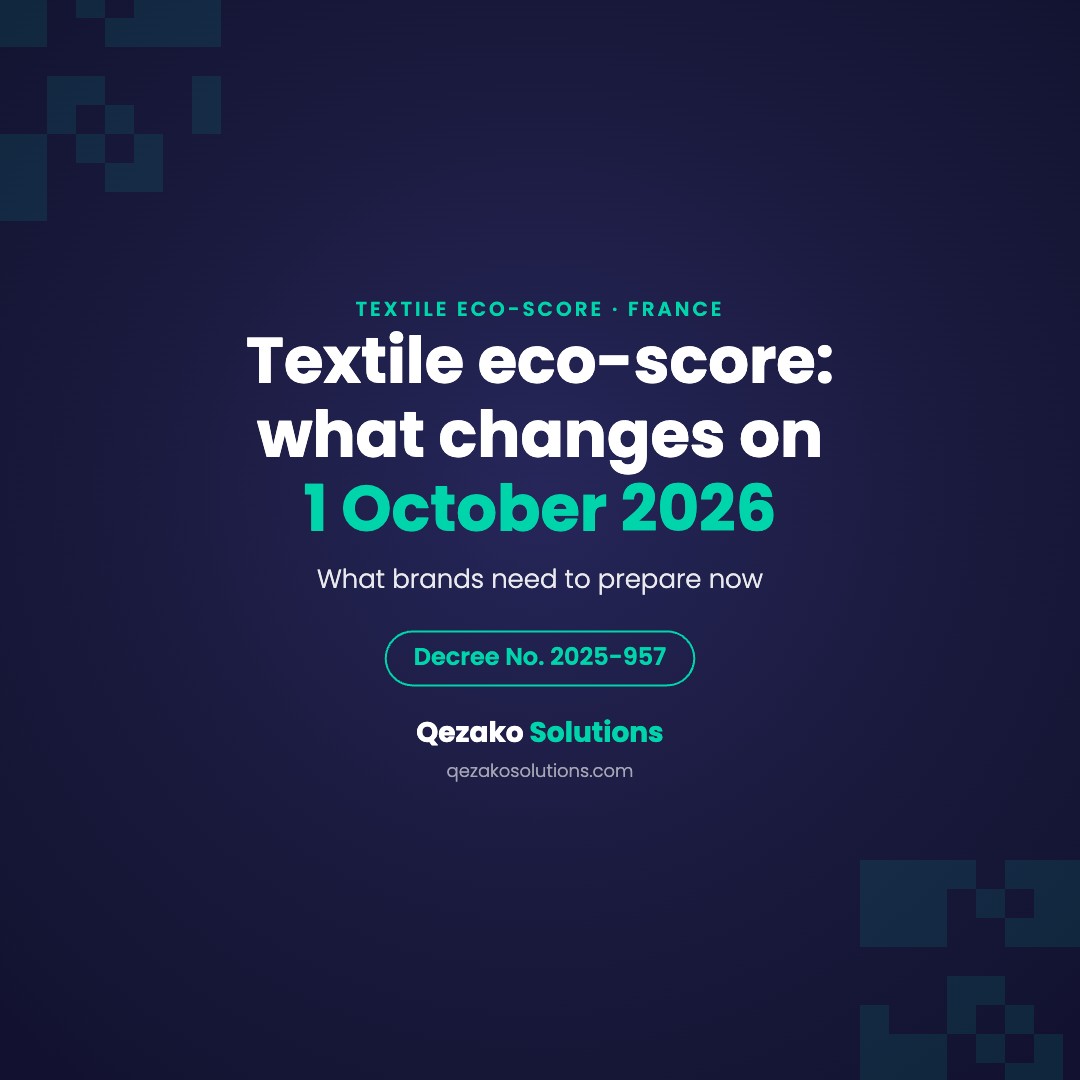
Since 1 October 2025, clothing brands in France have been able to display the environmental cost of their products, widely known as the textile eco-score. Many filed it under "voluntary, so not urgent". From 1 October 2026, that reading no longer holds. Here is what changes in two weeks, who is affected, and how to get ready without reprinting all your labels.
The textile eco-score in a nutshell
The environmental cost of textile products is governed by French Decree No. 2025-957 of 6 September 2025, implementing the Climate and Resilience Act. It is expressed in "impact points": the higher the score, the heavier the garment's environmental footprint.
The calculation relies on Ecobalyse, the public tool of the French Ministry for Ecological Transition. According to the ministry's official announcement, the method builds on the European Commission's PEF (Product Environmental Footprint), extended by France to cover microfibres, garment durability and end-of-life management.
In practice, a brand enters each product's characteristics (category, weight, composition, countries of the main manufacturing steps), declares the result on the official portal ecobalyse.beta.gouv.fr, then shows a standardised label in store or online. The label gives the total cost and the cost per 100 g.
What changes on 1 October 2026
Display remains voluntary. But the decree sets out a second stage, one year after launch, that shifts the balance for brands.
Third parties can calculate your score
From October 2026, a retailer, a comparison platform or an NGO can calculate and publish the environmental cost of one of your products without your consent. Without data from the brand, the calculation uses default assumptions, which are usually unfavourable. Staying silent no longer protects you: it simply lets others set your score.
Environmental claims require the official score
A brand that highlights another environmental figure on a product (carbon footprint, a quantified "eco-friendly" claim, an in-house score) will also have to display the official environmental cost. Ongoing CSR communication programmes are directly affected.
What is at stake for textile brands
- Control your score: a score calculated with your real data (material origin, manufacturing sites, durability) will almost always be fairer than a default one.
- Secure your messaging: every environmental claim must now be backed by the official score. The French consumer authority (DGCCRF) checks for misleading commercial practices.
- Keep data up to date: every new collection and every supplier change alters the calculation. The label has to follow.
- Get ready for Europe: the textile Digital Product Passport (DPP) will come with the same data requirements. Structuring your product data now saves time on both fronts.
On that last point, our article on the launch of the Central DPP Registry covers the European timeline.
Display the eco-score without reprinting your labels
The hardest part is not the calculation, it is keeping it current. A score printed on a label becomes wrong as soon as the method or the supply chain changes.
That is the approach behind Qezako's Textile Eco-Score module: a dynamic QR code on the label leads to a product page showing the environmental cost and related information. The content is updated online without changing the physical label, and the same page can later host the Digital Product Passport data.
| Date | Milestone |
|---|---|
| 6 September 2025 | Decree No. 2025-957 on the environmental cost of textile products |
| 1 October 2025 | Voluntary display and declaration portal go live |
| 1 October 2026 | Third-party calculation allowed, and official score required alongside any environmental claim |
Key takeaways
The textile eco-score is still voluntary, but from 1 October 2026, ignoring it means letting others calculate your score. Brands that prepare their data now keep control of both their score and their environmental message.
Is your brand ready for 1 October? Let's review your products and see how to display the eco-score through a dynamic QR code.